Carpet Area vs Super Built-Up Area Explained
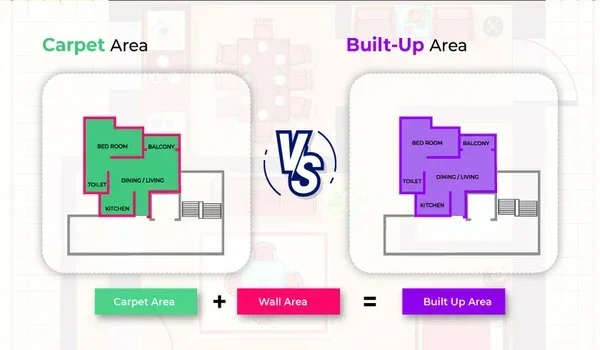
Carpet area measures an apartment’s usable internal floor area, including internal partition walls. Super built-up area adds the apartment’s built-up space and an allocated share of common areas. Under RERA, carpet area excludes external walls, service shafts, exclusive balconies, verandahs and open terraces. This makes it a useful starting point for comparing the space inside two homes.
A 1,500 sq. ft. super built-up apartment does not provide 1,500 sq. ft. of internal living space. For example, if its RERA carpet area is 1,000 sq. ft., the carpet-to-super-built-up ratio is 66.7%. At Sobha Parq city, advertised sizes range from 750 to 2,800 sq. ft. on a saleable-area basis, so buyers should compare each unit’s carpet area alongside its overall size.
What Is Carpet Area?
RERA carpet area covers the usable floor within the apartment, including the footprint of internal partition walls. Bedrooms, the living room, kitchen, bathrooms and internal passages form part of this measurement. Shared corridors and lift lobbies do not.
The term is sometimes described as “the area you can cover with a carpet.” That is only a rough explanation. Internal partition walls count under RERA even though furniture cannot occupy that space.
Balconies and exclusive open terraces are measured separately. A large balcony can add useful outdoor space, but it does not increase the apartment’s RERA carpet area.
What Is a Built-Up Area?
Built-up area generally includes the apartment’s carpet area, external wall footprint and attached balcony or other covered private spaces. It measures more than the usable interior but does not include the apartment’s allocated share of shared building facilities.
For example, a home could have 1,000 sq. ft. of carpet area and another 150 sq. ft. across external walls and balcony space. Its built-up area would then be 1,150 sq. ft. This is an illustration; the actual breakdown must come from the apartment’s area statement.
When using RERA carpet area in a calculation, internal partition walls are already included. Adding them again would count the same space twice.
What Is Super Built-Up Area?
Super built-up area combines built-up area with a proportionate share of specified common spaces. These can include shared lobbies, corridors, staircases and other covered facilities included in the project’s calculation. It is often described as saleable area.
The common-area share is an allocation, rather than additional private space inside the flat. A buyer cannot turn that allocated lobby or staircase area into another room.
Calculation methods and included spaces can differ between projects. The area statement should explain what has been added. Open gardens and outdoor facilities should not automatically be treated as part of the apartment’s super built-up measurement.
Carpet Area vs Super Built-Up Area: Key Differences
| Point of Comparison | RERA Carpet Area | Super Built-Up Area |
|---|---|---|
| Main purpose | Measures the apartment’s internal usable area | Expresses built-up area plus an allocated common-area share |
| Internal partition walls | Included | Included through the apartment area |
| External walls | Excluded | Generally included |
| Exclusive balcony | Excluded | Generally included through built-up area |
| Shared corridors and lobbies | Excluded | May form part of the allocated share |
| Best use for buyers | Comparing internal space | Understanding the advertised area and its breakdown |
A larger super built-up figure does not always mean larger rooms. Two apartments with the same advertised size can have different carpet areas, balcony sizes and common-area allocations.
How to Calculate Loading Percentage
Loading measures the difference between super built-up area and carpet area as a percentage of carpet area. Using that definition:
For a home with 1,500 sq. ft. super built-up area and 1,000 sq. ft. carpet area:
The 500 sq. ft. difference is also 33.3% of the super built-up area. These percentages use different bases, which is why they give different answers. Always check the denominator when comparing loading figures.
Converting Super Built-Up Area to Carpet Area
If the loading percentage is known, use:
Carpet area = Super built-up area ÷ (1 + Loading as a decimal)
For the same example:
1,500 ÷ 1.50 = 1,000 sq. ft.
Do not subtract 50% from 1,500 sq. ft. That would produce 750 sq. ft., which is incorrect. There is no reliable universal conversion without the unit’s actual loading or disclosed carpet area.
How Area Changes the Price per Sq. Ft.
The price per sq. ft. changes when the area basis changes, even if the apartment price stays the same. Consider a home priced at ₹1.50 crore, with 1,500 sq. ft. super built-up area and 1,000 sq. ft. carpet area.
Its price is ₹10,000 per super built-up sq. ft. The same price equals ₹15,000 per carpet sq. ft. Both calculations describe the same apartment.
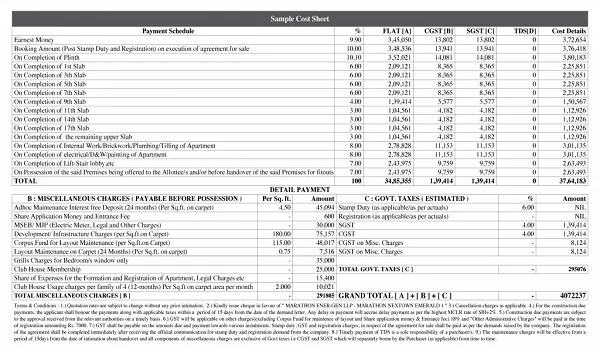
This matters when comparing two projects. A lower advertised rate may still produce a higher cost per carpet sq. ft. Use the same cost components and area basis for both homes before judging value.
Understanding Sobha Parq city’s Saleable Apartment Sizes
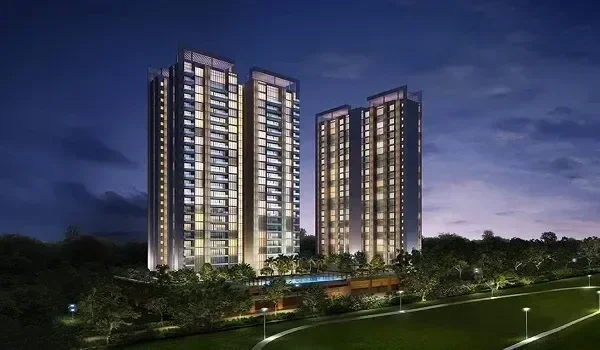
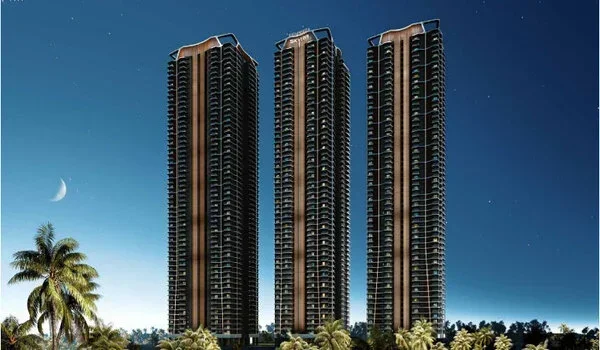
Sobha Parq city offers planned 1, 2, 3 and 4 BHK apartments from 750 to 2,800 sq. ft. SBA. The project is planned across 50 acres on Hennur Main Road, with more than 4,000 residences across 12 towers and 24 wings.
The stated saleable sizes are 750 sq. ft. for a 1 BHK, 1,050–1,350 sq. ft. for a 2 BHK, 1,530–1,840 sq. ft. for a 3 BHK and 2,200–2,800 sq. ft. for a 4 BHK. These figures should not be read as carpet areas.
For a shortlisted apartment, compare the carpet area, balcony area and room dimensions against the saleable size. The marked floor plan will show whether the living room, bedrooms and kitchen fit your needs. An assumed percentage cannot establish the carpet area of a specific Sobha Parq city unit.
Does a Higher Carpet-Area Ratio Mean a Better Home?
A higher carpet-to-saleable-area ratio gives more internal area for the same advertised size. That can improve value, but room shape and circulation also matter.
A home with long passages may offer less useful furniture space than a slightly smaller, well-arranged layout. Check bedroom widths, wardrobe walls, kitchen counters and dining space rather than relying only on the ratio.
Balconies deserve a separate assessment. They sit outside RERA carpet area but can still provide useful outdoor space. Compare internal space and outdoor space as distinct parts of the home.
What to Check Before Booking
Ask for an area statement showing RERA carpet area, balcony or terrace area, and the advertised saleable area. Match it to the exact tower, floor and unit number.
Next, compare the floor plan with the written quote and agreement details. Check whether the price calculation uses carpet area or another stated basis. Any difference in terminology should be clear before payment.
Finally, test the layout with your furniture. A dining table, bed or wardrobe needs clear dimensions and walking space. The area statement explains the measurement; the floor plan explains how you can use it.
FAQs
Yes. RERA carpet area includes internal partition walls. It excludes external walls and service shafts.
No. An exclusive balcony or verandah is excluded from RERA carpet area and should be identified separately.
No. A saleable area is often used for a super built-up area. Confirm the exact definition and breakdown used for the apartment.
Only if the actual apartment data supports that ratio. A fixed 70% assumption cannot establish the correct carpet area.
The stated 750–2,800 sq. ft. sizes are saleable-area figures. Compare the unit-specific carpet area and floor plan before choosing a home.
Use RERA carpet area to compare internal space. Assess balconies, layout quality, common facilities and total cost separately.